
AASI in ABPM: An Emerging Marker for Assessing Arterial Stiffness and Cardiovascular Risk
Beyond Blood Pressure: What More Can an ABPM Test Reveal?
Most clinicians are familiar with 24-hour Ambulatory Blood Pressure Monitoring (ABPM) for diagnosing hypertension, evaluating treatment efficacy and assessing blood pressure patterns throughout the day and night.
However, modern ABPM technology can provide much more than average blood pressure values.
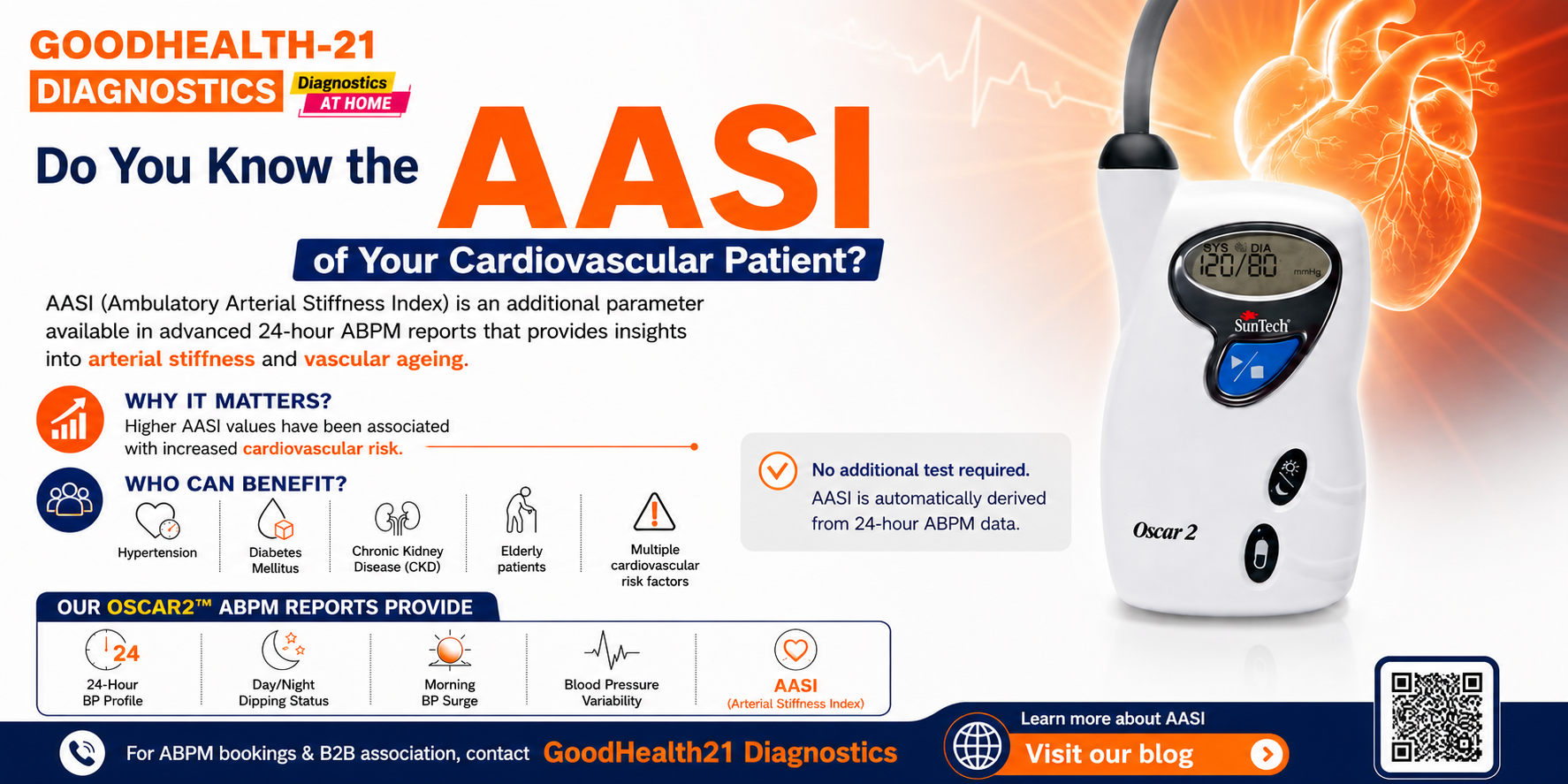
One of the valuable parameters available in advanced ABPM reports is the AASI (Ambulatory Arterial Stiffness Index), a marker that provides additional insights into arterial stiffness and overall cardiovascular risk.
At GoodHealth21 Diagnostics, AASI is available as part of our advanced ABPM analysis using the Oscar2™ ABPM system.
What is AASI?
AASI (Ambulatory Arterial Stiffness Index) is an indirect measure of arterial stiffness derived from 24-hour ambulatory blood pressure recordings.
It is automatically calculated from the relationship between systolic blood pressure (SBP) and diastolic blood pressure (DBP) recorded throughout a 24-hour ABPM study.
The formula is:
AASI = 1 − Regression Slope of DBP on SBP
No additional test or patient intervention is required. The value is automatically generated from the ABPM data.
Why Does Arterial Stiffness Matter?
Healthy arteries are elastic and expand easily when blood is pumped from the heart.
As people age, or in the presence of cardiovascular risk factors, arteries gradually become stiffer.
Increased arterial stiffness is associated with:
· Hypertension
· Diabetes mellitus
· Chronic kidney disease
· Atherosclerosis
· Stroke
· Coronary artery disease
· Heart failure
Arterial stiffness is also considered a marker of vascular ageing.
Why is AASI Clinically Useful?
AASI should not be considered a standalone diagnostic test.
However, it provides additional information for cardiovascular risk stratification when interpreted alongside clinical findings.
Several studies have demonstrated that higher AASI values are associated with:
· Increased cardiovascular mortality
· Increased stroke risk
· Major adverse cardiovascular events (MACE)
· Target organ damage
· Left ventricular hypertrophy
· Progression of kidney disease
Recent meta-analysis data involving more than 28,000 patients showed that elevated AASI was associated with increased risk of cardiovascular death, stroke and major adverse cardiovascular events.
Which Patients May Benefit from AASI Assessment?
AASI may provide additional value in patients with:
Hypertension
· Newly diagnosed hypertension
· Long-standing hypertension
· Resistant hypertension
· Uncontrolled hypertension
Diabetes Mellitus
Long-standing diabetes accelerates vascular ageing and arterial stiffness.
Chronic Kidney Disease (CKD)
CKD is strongly associated with vascular dysfunction and increased cardiovascular risk.
Elderly Patients
AASI may provide insight into age-related vascular changes.
Patients with Multiple Cardiovascular Risk Factors
Particularly patients with:
· Obesity
· Dyslipidemia
· Smoking history
· Family history of premature cardiovascular disease
Patients with Previous Stroke
Additional vascular assessment may support long-term risk evaluation.
How is AASI Obtained?
AASI is generated from a standard 24-hour ABPM study.
The patient wears a portable blood pressure monitor for 24 hours while continuing normal daily activities.
The report provides several clinically useful parameters, including:
· 24-hour average blood pressure
· Daytime and nighttime blood pressure
· Dipping status
· Morning blood pressure surge
· Blood pressure variability
· Pulse pressure
· AASI (Ambulatory Arterial Stiffness Index)
No additional procedure is required.
Oscar2™ ABPM Supports Advanced Cardiovascular Assessment
At GoodHealth21 Diagnostics, we utilize the Oscar2™ Ambulatory Blood Pressure Monitor to provide comprehensive 24-hour blood pressure analysis.
In addition to conventional blood pressure assessment, the ABPM report supports advanced interpretation parameters such as:
· 24-hour blood pressure trends
· Day-night dipping analysis
· Blood pressure variability
· Morning surge assessment
· AASI for arterial stiffness evaluation
These parameters may help clinicians obtain a broader understanding of a patient’s cardiovascular profile.
Important Clinical Note
AASI should not be interpreted in isolation.
It is an adjunctive parameter and should always be interpreted alongside:
· Patient age
· Blood pressure profile
· Cardiovascular risk factors
· Medical history
· Clinical examination findings
It is intended to support cardiovascular risk assessment and not replace established diagnostic methods.
Conclusion
ABPM has evolved from being simply a blood pressure monitoring tool into a comprehensive cardiovascular assessment tool.
AASI provides additional insights into arterial stiffness and vascular ageing, helping clinicians better understand a patient’s overall cardiovascular status.
For patients at increased cardiovascular risk, advanced ABPM reporting may provide valuable information beyond traditional blood pressure measurements.
References
-
Li Y, Wang JG, Dolan E, et al. Ambulatory Arterial Stiffness Index Derived From 24-Hour Ambulatory Blood Pressure Monitoring. Hypertension. 2006;47:359-364.
-
Dolan E, Thijs L, Li Y, et al. Ambulatory Arterial Stiffness Index as a Predictor of Cardiovascular Mortality in the Dublin Outcome Study. Hypertension. 2006;47:365-370.
-
Hansen TW, Staessen JA, Torp-Pedersen C, et al. Ambulatory Arterial Stiffness Index Predicts Stroke in a General Population. Journal of Hypertension. 2006.
-
Boos CJ, et al. Ambulatory Arterial Stiffness Index, Mortality and Adverse Cardiovascular Outcomes: Systematic Review and Meta-analysis. Journal of Clinical Hypertension. 2024.
-
Verbakel JRA, et al. The Use of the Ambulatory Arterial Stiffness Index in Patients with Difficult-to-Treat Hypertension. Frontiers in Cardiovascular Medicine. 2016.


