At first, numbness in hands or legs is not a major problem. It may be tingling, a feeling of “pins and needles,” or lack of sensation in certain parts of the body. When numbness occurs often, spreads to other areas, and continues for long, there might be some underlying nerve problem.
Not giving attention to these conditions will lead to deterioration of the nerve condition. In that case, NCV Test or Nerve Conduction Velocity Test should be done to check the performance of nerves conducting electrical impulses.
GoodHealth21 Diagnostics provides reliable NCV Test services in Delhi using quality testing equipment and professional support. Trained technicians perform the test according to the recommended diagnostic procedure to help ensure accurate nerve conduction measurements and reliable results.
What Is an NCV Test?
A NCV test or Nerve Conduction Study (NCS) is a medical test which analyzes the speed and effectiveness of electrical activity that passes through your nerves. All the nerves of our body contain electrical signals which transfer information from our brain, spinal cord, and muscles. In case when there is some injury, pressure, or disease of the nerve, the speed and strength of these signals become lower.
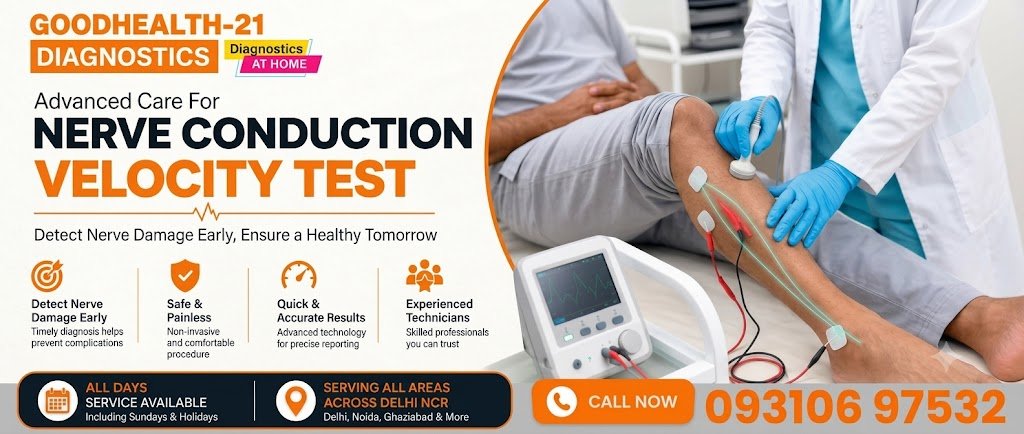
In the course of the NCV test, some electrodes are attached to the skin over certain nerves, and then a weak electrical signal is delivered to the nerve. The speed and strength of electrical signals are measured and analyzed by the electrodes at the end of their travel.
The most frequently examined areas by NCV tests are the nerves of the arms, hands, legs, and feet.
Why Is an NCV Test Done for Numbness?
Numbness occurs due to nerve dysfunction that prevents the transmission of sensory signals to the brain. However, the presence of numbness does not provide any information regarding which nerve has been affected, the location of the problem on its path, and the severity of the impairment. That is precisely what the NCV test is used for.
The main reasons to use the NCV test for numbness are as follows:
Confirm that the numbness occurs due to nerve injury and not other causes, such as circulation problems, muscular disorders, or issues with the spine Identify the specific nerve and the location of the problem, e.g., a nerve in the wrist for carpal tunnel syndrome, or a nerve in the spine in the case of sciatica Identify problems in nerve conduction and contribute to the assessment of conditions such as carpal tunnel syndrome, peripheral neuropathy, and certain nerve problems linked to radiculopathy Evaluate the extent of nerve damage
Monitor the development or improvement of a condition such as diabetic neuropathy
Exclude or diagnose a condition such as Guillain-Barré Syndrome, peripheral neuropathy, or nerve entrapment
Numbness can have multiple causes, and therefore the NCV test provides doctors with objective measurements of nerve function rather than the symptoms reported by patients.
Common Causes of Numbness in Hands and Legs
Numbness in the hands and legs can result from a wide range of conditions, including:
- Diabetes — high blood sugar over time can damage peripheral nerves, leading to diabetic neuropathy
- Carpal Tunnel Syndrome — compression of the median nerve at the wrist, common in people who type or use their hands repetitively
- Herniated or slipped disc — pressure on spinal nerve roots can cause numbness that radiates down the arm or leg
- Sciatica — compression of the sciatic nerve causing numbness or tingling from the lower back down to the leg and foot
- Vitamin B12 deficiency — a common and often overlooked cause of nerve-related numbness
- Poor blood circulation — reduced blood flow to the extremities, especially in smokers or people with vascular disease
- Guillain-Barré Syndrome — a rare autoimmune condition that attacks peripheral nerves
- Prolonged pressure or posture — sitting or lying in one position for too long
- Thyroid disorders and autoimmune diseases — can also contribute to nerve-related symptoms
Since many of these causes overlap in symptoms, an NCV test helps narrow down the actual source of the problem rather than leaving it to guesswork.
Symptoms That May Require an NCV Test
Not every instance of numbness needs testing — a foot that “falls asleep” after sitting cross-legged usually resolves on its own. However, doctors generally recommend an NCV test when numbness is accompanied by:
- Numbness or tingling that doesn’t go away or keeps recurring
- A burning or “pins and needles” sensation in the hands, feet, or legs
- Muscle weakness or difficulty gripping objects
- Numbness that spreads or moves from one area to another
- Pain that radiates from the back or neck into the arms or legs
- Loss of sensation to touch, heat, or cold
- Difficulty walking or a change in balance
- Numbness linked to a known condition like diabetes or a recent injury
If you’re experiencing any of these persistently, it’s worth discussing an NCV test with your doctor rather than waiting for symptoms to worsen.
How Is an NCV Test Performed?
The NCV test is a straightforward outpatient procedure that usually takes between 30 minutes to an hour, depending on how many limbs or nerves are being studied. Here’s what typically happens:
- Preparation — You’re asked to remove jewellery, watches, and any metallic objects, and avoid applying oil or lotion to your skin before the test.
- Electrode placement — A technician places small adhesive electrodes on the skin over the nerve being tested, along with a stimulating electrode a short distance away.
- Stimulation — A brief, mild electrical pulse is passed through the stimulating electrode. This may cause a slight tingling or twitching sensation, but it isn’t typically described as painful.
- Recording — The equipment records how fast the impulse travels between the two points and how strong the response is by the time it’s picked up by the recording electrode.
- Repeat for other nerves — The process is repeated for each nerve being studied — this could include nerves in one limb or all four limbs, depending on your symptoms.
There’s no downtime after the test, and you can resume your daily activities right away. No fasting or sedation is required.
NCV Test for Nerve Damage and Neuropathy
One of the most important uses of the NCV test is diagnosing and evaluating peripheral neuropathy — damage to the nerves outside the brain and spinal cord that most commonly affects the hands and feet.
The test helps doctors distinguish between two broad categories of nerve damage:
- Axonal damage — where the nerve fibre itself is damaged, often reducing the strength of the signal
- Demyelinating damage — where the protective covering (myelin) around the nerve is damaged, which typically slows down signal speed
This distinction matters because it guides treatment. For example, diabetic neuropathy, alcohol-related neuropathy, and vitamin deficiency-related nerve damage often show different NCV patterns compared to autoimmune or compression-related nerve disorders. NCV testing, often paired with an EMG, gives doctors a clearer picture of the type, location, and severity of nerve damage — helping shape a more targeted treatment plan.
NCV Test Cost in Delhi
NCV test cost in determined primarily depending on the number of limbs that need to be examined, the diagnosis center, and whether the test is taken along with an EMG test. At Goodhealth21 Diagnostics, we conduct NCV tests for either two limbs or four limbs, as recommended by your doctor:
NCV Test Price: ₹3,500 – ₹5,000
The number of limbs for which the NCV test is to be done is normally determined by your doctor according to your condition, e.g., if the numbness is restricted to either one side of your body or a particular limb, then only two limbs need to be evaluated for the test, whereas if you have general or bilateral numbness, then all four limbs should be included for a comprehensive nerve evaluation. It would be wise to check from your doctor how many limbs need to be tested, and also whether the report is to be reviewed by a neurologist.
NCV Test in Delhi
For patients experiencing numbness, tingling, weakness, pain, or other nerve-related symptoms, an NCV test can help evaluate how well the nerves are functioning. The test uses specialized equipment to measure the speed and strength of electrical signals traveling through the nerves.
It may be recommended for:
- Numbness or tingling in the hands or feet
- Muscle weakness or reduced strength
- Suspected nerve compression or nerve damage
- Diabetes-related nerve evaluation
- Persistent pain or changes in sensation
The test is performed by a trained technician using appropriate diagnostic equipment. After recording the nerve responses, the results are analyzed and a detailed report is prepared for further evaluation by the treating doctor or neurologist.
GoodHealth21 Diagnostics provides professional nerve conduction testing in Delhi with trained technicians, quality equipment, and reliable reporting support.
NCV Test vs EMG
NCV and EMG (Electromyography) are often mentioned together, and doctors frequently recommend them as a combined study — but they test different things.
| Aspect | NCV Test | EMG Test |
| What it measures | Speed and strength of electrical signals through nerves | Electrical activity within muscles |
| How it’s done | Electrodes placed on the skin, mild electrical stimulation | A thin needle electrode inserted into the muscle |
| What it detects | Nerve damage, compression, or slowed conduction | Muscle disorders and how well muscles respond to nerve signals |
| Discomfort level | Mild tingling sensation | Slight discomfort from the needle insertion |
| Common use | Carpal tunnel, neuropathy, sciatica, nerve injury | Muscle weakness, ALS, muscular dystrophy, nerve-muscle disorders |
NCV Test Cost: ₹3,500 – ₹5,000
When numbness is combined with muscle weakness, doctors often recommend both tests together, since NCV identifies the nerve problem while EMG shows how the muscles are responding to it. This combined approach gives a more complete diagnosis than either test alone.
FAQs
- Is the NCV test painful? Most people describe it as a mild tingling or twitching sensation rather than pain. Some discomfort is normal, but it’s brief and well tolerated by most patients.
- How long does an NCV test take? A single-limb test can take around 20–30 minutes, while a full four-limb study may take closer to an hour.
- Do I need to fast before an NCV test? No fasting is required. You should avoid applying oils or lotions to your skin and remove jewellery or metallic objects before the test.
- Can diabetics get an NCV test done regularly? Yes. Diabetic patients are often advised to get periodic NCV tests to monitor nerve health and catch diabetic neuropathy early.
- Is NCV testing available at home in Delhi? Yes. Goodhealth21 Diagnostics and several other diagnostic centres in Delhi offer home NCV testing using portable equipment, especially useful for elderly or mobility-restricted patients.
- What’s the difference between NCV and EMG? NCV measures how well nerves conduct electrical signals, while EMG measures the electrical activity of muscles. They’re often done together for a complete diagnosis.
- How soon will I get my NCV test report? Reports are usually available within a few hours to a day, and are typically reviewed by a neurologist before being handed over.
- Can numbness go away without needing an NCV test? Occasional, short-lived numbness (like your foot “falling asleep”) often resolves on its own. Persistent, recurring, or spreading numbness should be evaluated, and an NCV test may be recommended by your doctor.
Conclusion
Numbness in the hands or legs is often your body’s way of signaling that a nerve isn’t working the way it should — whether due to diabetes, a compressed nerve, a vitamin deficiency, or something more serious like Guillain-Barré Syndrome. Ignoring persistent or recurring numbness can delay diagnosis and make treatment harder down the line.
An NCV test provides doctors with measurable information about nerve function, including which nerves may be affected and the extent of the problem. It can help evaluate numbness, tingling, pain, weakness, and other nerve-related symptoms. Whether a 2-limb or 4-limb study is required, the test should be performed using appropriate equipment by experienced technicians, with the results reviewed by the treating doctor or neurologist.
If you have persistent numbness, tingling, pain, or weakness in your hands or legs, consult your doctor to determine whether this test is appropriate for you. GoodHealth21 Diagnostics provides professional testing in Delhi with trained technicians, quality equipment, and detailed reports. Book your NCV Test in Delhi today or contact our team to check availability and appointment details.
 Call Now: 9310697532
 Service Areas We Cover in & Around Delhi
We provide NCV Test services across Delhi including all major locations.
NCV Test in South Delhi
Greater Kailash (GK I & II), Lajpat Nagar, Hauz Khas, Vasant Kunj, Vasant Vihar, Green Park, Saket, Defence Colony, Kalkaji, Alaknanda, Chittaranjan Park (CR Park), East of Kailash, New Friends Colony, Sarita Vihar, Govindpuri, Mehrauli, Malviya Nagar, Amar Colony, Sheikh Sarai, Pushp Vihar, Madangir, Ambedkar Nagar and nearby areas.
NCV Test in Central Delhi
Connaught Place (CP), Karol Bagh, Rajendra Place, Patel Nagar, Paharganj, Daryaganj, Civil Lines, ITO, Minto Road, Mandi House, Jhandewalan, Pusa Road, Ranjit Nagar, Nabi Karim and nearby areas.
NCV Test in West Delhi
Janakpuri, Vikaspuri, Uttam Nagar, Tilak Nagar, Rajouri Garden, Punjabi Bagh, Paschim Vihar, Hari Nagar, Subhash Nagar, Kirti Nagar, Moti Nagar, Tagore Garden, Ramesh Nagar, Karam Pura, Ashok Nagar, Dwarka (Sector 1–23), Najafgarh, Palam, Dabri, Bindapur and nearby areas.
NCV Test in East Delhi
Preet Vihar, Laxmi Nagar, Patparganj, Mayur Vihar (Phase I, II & III), IP Extension, Pandav Nagar, Anand Vihar, Nirman Vihar, Shahdara, Karkardooma, Krishna Nagar, Vivek Vihar, Geeta Colony, Mandawali, Jagatpuri, Surajmal Vihar, Trilokpuri, Kalyanpuri, Ghazipur and nearby areas.
NCV Test in North Delhi
Model Town, Kamla Nagar, Mukherjee Nagar, GTB Nagar, Civil Lines, Ashok Vihar, Shalimar Bagh, Rohini (All Sectors), Azadpur, Adarsh Nagar, Jahangirpuri, Timarpur, Burari, Sant Nagar, Derawal Nagar, Kohat Enclave and nearby areas.
NCV Test in North West & North East Delhi
Pitampura, Saraswati Vihar, Rani Bagh, Mangolpuri, Sultanpuri, Bawana, Narela, Badli, Bhalswa, Karawal Nagar, Seelampur, Maujpur, Brahmpuri, Gokulpuri, Khajuri Khas, Sonia Vihar, Mustafabad and nearby areas.
NCV Test in South West Delhi
Dwarka (Sector 1–23), Palam, Mahipalpur, Vasant Vihar, Vasant Enclave, Delhi Cantt, Mahavir Enclave, Kapashera, Bijwasan, Chhawla, Matiala, Najafgarh, Dabri, Gopal Nagar, Nangli Sakrawati and nearby areas.
We provide reliable NCV Test services across Delhi & NCR with convenient doorstep testing, experienced technicians, and accurate digital reports.


