Are you a snorer every night? Do you wake up feeling unrefreshed? Or do you feel unable to stay awake until afternoon? Most people attribute this to stress, screen addiction, or city lifestyle. If your fatigue lasts for weeks on end, the reason might lie with your own sleep patterns, and a sleep test in Noida will tell you more about that.
Sleep testing doesn’t require any special effort from you. You just have to sleep, and a series of sensors will measure your respiratory, oxygenation and heart rates throughout the night. This blog post will discuss what a sleep test entails, who needs it, its types, preparations and cost.
Call Now : 093106 97532
What Is a Sleep Test and How Does It Work?
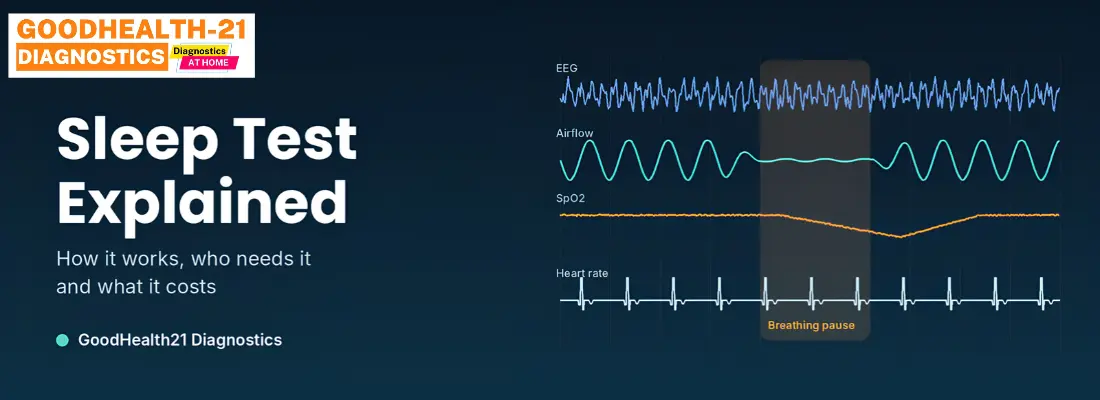
A sleep test or a sleep study is a nighttime evaluation of how your body adjusts to sleep. Sensors attached to the scalp, chest, fingertip, and below the nose monitor your body’s response while sleeping. The information recorded is later analyzed by a specialist for any irregularity.
Depending on the study, the equipment measures:
- How much air moves in and out as you breathe
- How hard your chest and abdomen work to breathe
- The oxygen saturation in your blood
- Your pulse and heart rhythm
- Snoring sounds and sleeping position
- Brain activity, eye movement and muscle tone (only in detailed studies)
From this data, the report calculates the Apnea-Hypopnea Index (AHI), which is the number of breathing interruptions per hour of sleep. A higher AHI points to more severe sleep apnea. The recording may also uncover leg movements during sleep or frequent awakenings you never noticed.
Why Is a Sleep Test Recommended?
Doctors suggest this test when your complaints point towards poor sleep but routine examination and blood tests show nothing clear. Typical situations include:
- Your partner says you snore loudly or seem to stop breathing briefly
- You sleep a full night but still wake up exhausted
- Your blood pressure stays high even with medicines
- A doctor wants to confirm sleep apnea before starting CPAP or BiPAP
- You already use a CPAP or BiPAP machine and the settings need review
Ignoring sleep apnea can put long-term pressure on the heart and blood vessels. It is associated with hypertension, rhythm problems, diabetes and a greater chance of drowsy-driving accidents. Testing early gives you more treatment options.
Common Symptoms That May Require This Test
Consider getting tested if you regularly experience a few of the following:
- Heavy, frequent snoring
- Sudden gasps or choking sounds at night
- A dry throat or headache when you wake up
- Falling asleep during the day, at work or behind the wheel
- Trouble focusing or remembering things
- Short temper or low mood
- Several bathroom trips every night
- Uncomfortable urges to move your legs when you lie down
An occasional bad night is normal. Symptoms that continue for several weeks need attention.
Who Should Consider This Test?
You are more likely to benefit from a sleep test if:
- You snore and feel sleepy during the day
- You carry extra weight, especially around the neck
- You have hypertension, diabetes or a heart condition
- Someone in your family has sleep apnea
- You drive long distances, work night shifts or hold a safety-critical job
- You are above 40 or 50 years of age
- You have been told your breathing stops while you sleep
- Your child snores, breathes through the mouth or has poor concentration at school (see a paediatrician first)
Types of Sleep Test
Not every sleep test records the same things. Your doctor will choose the one that fits your symptoms.
- Polysomnography (PSG / Level 1): The most detailed option. It tracks brain waves, eye and muscle activity, breathing, oxygen and heart signals together. It suits cases where the cause is uncertain or more than one problem is suspected.
- Level 2 Sleep Study: A broad study with many recording channels, useful when a thorough picture of your sleep is needed.
- Level 3 Sleep Study (HSAT): A focused test that captures airflow, breathing effort, oxygen and heart rate. It is commonly chosen when obstructive sleep apnea looks likely and there are no other complicated health issues.
- CPAP / BiPAP titration: Performed after diagnosis to find the pressure setting that works best for your therapy.
How Is the Test Performed?
- Arrival: You reach the centre in the evening, and the technician explains what will happen.
- Setting up: Sensors are fixed to your body with soft pads and straps, which takes about 30 to 45 minutes. It does not hurt.
- Going to bed: You lie down at your usual bedtime and turn freely as you normally would.
- Recording: The machine collects data all night, and the technician corrects any loose sensor.
- Morning: The sensors are taken off and you can leave for your day.
- Reporting: A specialist examines the recording and writes up the findings.
How to Prepare for the Test
A few simple habits help the test capture your natural sleep:
- Follow your regular routine and skip daytime naps
- Avoid tea, coffee and cola after lunchtime
- Stay away from alcohol on the day of the test
- Wash your hair beforehand and do not apply oil, gel or spray
- Take off nail polish from at least one finger so the oxygen sensor can read properly
- Wear comfortable, loose night clothes
- Bring your usual medicines and let the technician know about them
- Carry your CPAP or BiPAP machine and old reports if you have any
Never stop a prescribed medicine by yourself. Check with your doctor first.
How Long Does the Test Take?
It is an overnight test, so keep aside roughly 8 hours for sleep, plus some time for setup in the evening. The recording is analysed after you wake up, and the report follows. How soon it is ready depends on the type of study. Your doctor then goes through the results with you and discusses the next steps.
Benefits and Importance of the Test
- Answers your doubts: It confirms whether sleep apnea or another disorder is behind your symptoms.
- Shows how serious it is: The AHI score classifies the condition as mild, moderate or severe.
- Points to the right treatment: Options range from lifestyle changes and oral devices to CPAP or BiPAP.
- Looks after your heart: Treating sleep apnea eases the load on blood pressure and heart rhythm.
- Improves daily life: Better sleep often means more energy, steadier mood and sharper focus.
- Reduces risk: Staying alert helps you work and drive more safely.
Test Cost and Factors Affecting Price
Before choosing a sleep test in Noida, it helps to know that the price mainly depends on how detailed the study is. At GoodHealth21 Diagnostics, the charges are:
| Test | Price |
| Sleep Study Level 3 | ₹4,500 |
| Sleep Study Level 2 | ₹8,000 |
| PSG Test | ₹8,000 |
Several things can change the final amount:
- Study type: a test with more channels costs more
- Place of testing: hospital or diagnostic centre
- Reporting and consultation: whether a specialist’s opinion is included
- Add-ons: such as a titration study or a follow-up visit
- Insurance: policies differ, so confirm with your insurer
Ask the centre exactly what the quoted price covers before you book.
Frequently Asked Questions (FAQs)
- What is the cost of a sleep study test?
The price depends on which study you need. At GoodHealth21 Diagnostics, a Level 3 sleep study is ₹4,500, and both the Level 2 sleep study and the PSG test are ₹8,000. Extra services such as a titration study may add to the total. - What are the 7 types of sleep disorders?
Sleep disorders are generally grouped into seven categories:
- Insomnia: difficulty falling asleep or staying asleep
- Sleep-related breathing disorders: for example, obstructive sleep apnea
- Hypersomnolence disorders: extreme daytime sleepiness, such as in narcolepsy
- Circadian rhythm disorders: a body clock out of step with daily life, as in shift-work problems
- Parasomnias: unusual behaviour during sleep, such as sleepwalking or night terrors
- Sleep-related movement disorders: for example, restless legs syndrome
- Other sleep disorders: conditions that do not fit the groups above
- Is a sleep test safe?
Yes. Nothing is inserted into your body and no needles or medicines are used. The sensors simply rest on the skin. A few people feel slight irritation from the adhesive or notice the wires at first. If you have a known skin allergy, tell the technician in advance. - What is the 3% rule for sleep apnea?
It is a scoring rule used while reading a sleep study. A partial drop in airflow lasting at least 10 seconds is counted as a hypopnea if it comes with an oxygen fall of 3% or more, or with a brief awakening. Some guidelines use a stricter 4% oxygen drop instead, so the AHI can vary a little depending on the rule applied. - What are 5 symptoms of sleep apnea?
Five common signs are:
- Loud snoring on most nights
- Choking or gasping during sleep
- Breathing pauses that someone else notices
- Persistent sleepiness during the day
- A morning headache or dry mouth
- Can sleep apnea be cured naturally?
Mild cases may improve with lifestyle changes. Losing weight, exercising, quitting smoking, avoiding alcohol close to bedtime and sleeping on your side can all help. Moderate or severe sleep apnea usually needs medical therapy such as CPAP or BiPAP. A sleep test can tell you how serious your condition is before you decide on treatment. - How do I know whether I need PSG or a Level 3 study?
If your symptoms clearly suggest sleep apnea and you have no other major health problem, a Level 3 study is often enough. If the cause is unclear or your symptoms are mixed, your doctor may recommend PSG or a Level 2 study. - What happens if the test shows sleep apnea?
Your doctor will plan treatment according to the severity. This may include weight management, changes in sleeping position, a CPAP or BiPAP machine, or further specialist evaluation.
Conclusion
Heavy snoring, unrefreshing sleep and daytime drowsiness are signals worth listening to. A sleep test is an easy, painless way to understand what is going wrong at night and to begin the right treatment.
If you are looking for a sleep test in Noida, GoodHealth21 Diagnostics provides Level 2, Level 3 and PSG studies with transparent pricing and doctor-guided care. Call 093106 97532 to book your test.
📍 Rajhans Plaza, A-209, Orange County, Ahinsa Khand 1, Indirapuram, Ghaziabad
📞 093106 97532
🗺️ https://maps.app.goo.gl/qvBNHJDn7vw4MpKLA


